

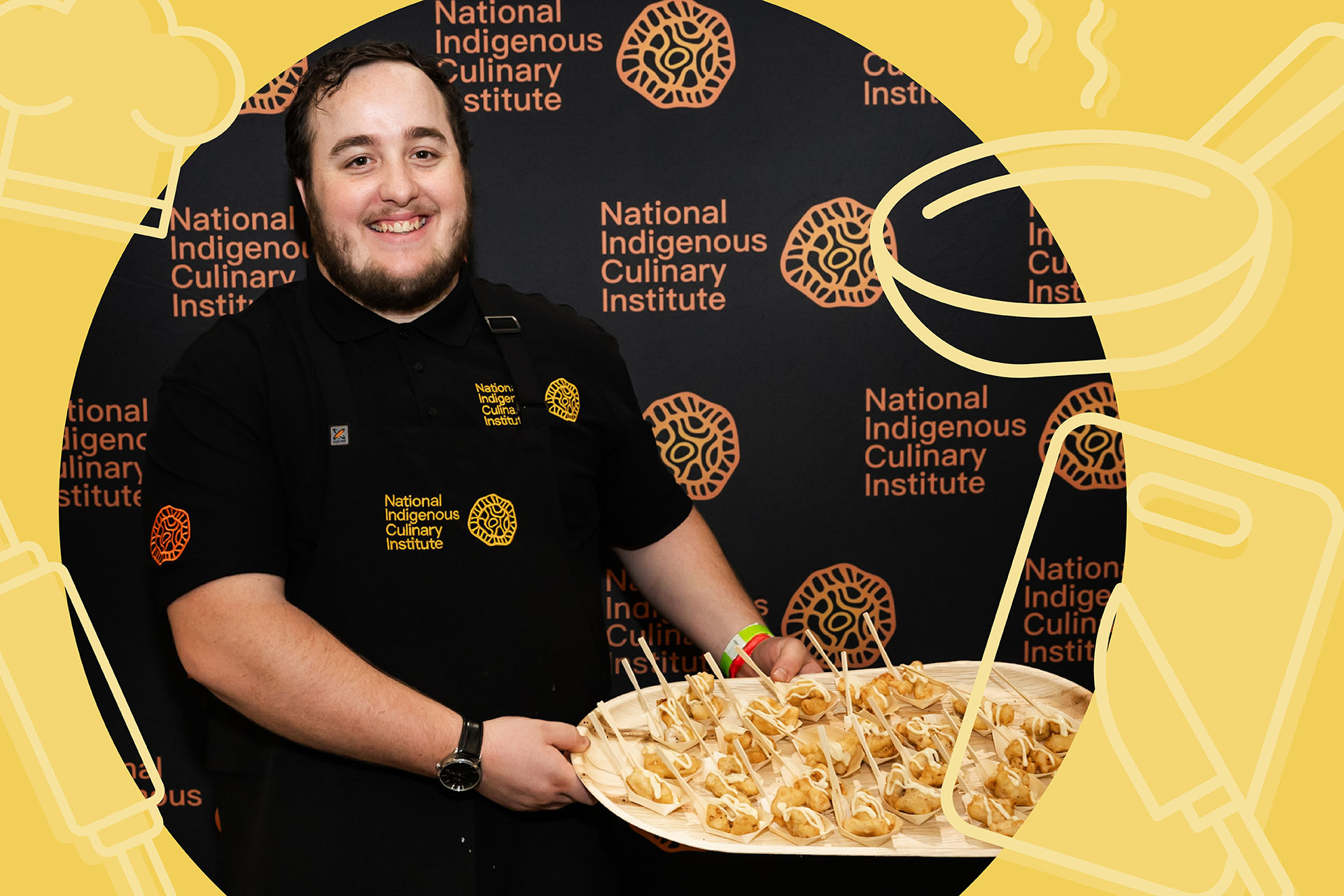
The National Indigenous Culinary Institute (NICI) was born out of a practical challenge: how can more Aboriginal and Torres Strait Islander people be supported to become successful chefs, not just in training, but in real kitchens, in real jobs?
Created by industry leaders Neil Perry, Guillaume Brahimi, Matt Moran and Luke Mangan – together with hospitality heavyweights Jill Dupleix, Terry Durack and the late Michael McMahon – NICI is an Aboriginal-led organisation that builds lasting employment pathways in hospitality. It works because it was designed in direct response to what the industry asked for: job-ready skills, strong mentorship and ongoing support.
At the heart of its operation is the Skills for Success training program. Before apprentices step into a commercial kitchen, they complete a focused three-to-five-week pre-employment course that teaches the core skills needed to succeed – safe and confident knife use, equipment handling, food prep and kitchen terminology. They also learn foundational cooking techniques, such as preparing pizza dough, fresh pasta, precision cuts, working with meat and poultry and maintaining kitchen hygiene. Alongside this, students are taught the professional behaviours that matter just as much, punctuality, presentation, teamwork and attitude.
For Nathan Lovett, NICI’s CEO for the past five years, this focus on fundamentals makes the difference. “The program is about giving apprentice chefs the skills they need to succeed,” he says.
Nathan left a career in the finance sector to take on the role, driven by the belief that economic participation is one of the most powerful ways to support the Aboriginal community. “We guarantee employment to every student who finishes the program,” he says. “And 80 per cent of the students who start our program complete the program.”
NICI partners with over 500 venues around the country, including restaurants, hotels, casinos, cafés and catering businesses to place apprentices and support their development. “Of the students who finish our program, 60 per cent complete their apprenticeship.” This is compared to the national average of 42 per cent.
Nathan attributes this success to NICI’s deep commitment to mentorship. The organisation acts as an extension of each partner venue’s HR team, offering the kind of long-term relationship many young chefs wouldn’t otherwise have.
“If a student needs anything, the chef will contact me directly and we’ll follow it up immediately,” he says. “We also have a strong focus on mental health. Our students have access to free, immediate counselling.”
This relationship doesn’t end with the apprenticeship. NICI remains a steady presence in the lives of its graduates, offering ongoing, practical support as they progress through their careers. “We’ve also got a client-for-life mentality,” Nathan adds. “We continue to support our alumni throughout their careers, helping them out with uniforms, shoes and equipment.”
As apprentices build technical confidence and grow into chefs, Nathan sees this as an opportunity for cultural connection. “Through the events we run and catering opportunities, our students are initially exposed to a range of native ingredients. And while the focus is always on assisting them to grow as chefs, food is a pathway to culture,” he says. “First and foremost, though, it’s about economic participation.”
Recently, Nathan was invited to speak on a panel about Indigenous cuisine and the deeper relationship between food and culture. The discussion centred on how each Country and language group holds a distinct food culture, rooted in a deep system of knowledge, practice and identity, as rich and varied as dance, song and ceremony.
“Food is the centrepiece of culture. It’s about understanding the seasonal knowledge that underpins it. Some areas have six seasons, and when one ingredient is in season, it signals that another one is too — it’s all connected.”
NICI also runs a school-based program designed to introduce younger Aboriginal and Torres Strait Islander students to food and culture. “The goal is to introduce connection to culture through food,” Nathan says. “Food becomes a way to explore identity, understand tradition and start meaningful conversations about culture.”
Every part of NICI’s work is grounded in a simple idea – strong chefs don’t happen by accident. They’re built through structure, mentorship and belief. And when that structure responds to real industry needs – while honouring culture, community and care – it doesn’t just support apprentices; it creates chefs who lead, inspire and bring something bigger to the plate.
If your organisation or business would like to support the NICI or is interested in employing apprentices and trainees, please contact Nathan Lovett at nathan@nici.org.au.